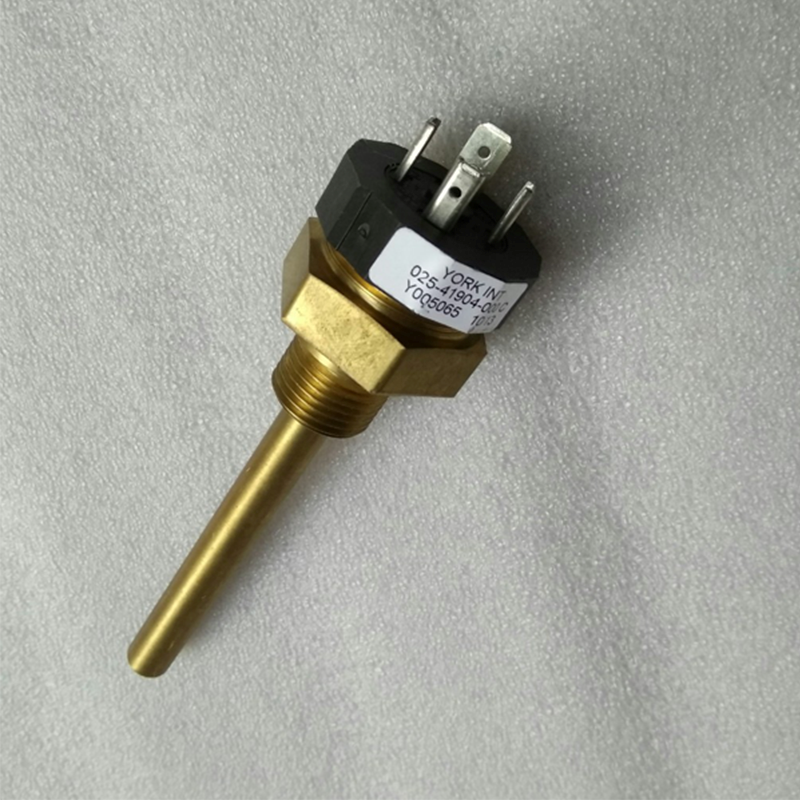
Products Description

| Product Name | Yk 025-41904-000 Temperature Sensor |
| Model | 025-41904-000 |
| Applicable Industries | Construction and Commercial |
| Application | Refrigeration compressor |
| Packaging | Cardboard Box |
| MOQ | 1 Piece |
Yk 025-41904-000 Temperature Sensor: Structure and Working Principle
1.Sensing Core: A high-precision resistive element that translates temperature fluctuations into precise changes in electrical resistance, thereby transmitting the temperature signal.
2.Signal Interface:Standardized wiring terminals designed to interface seamlessly with the signal ports on original Yk unit control boards, ensuring “plug-and-play” compatibility.
3.Sealing and Protection:A fully sealed enclosure isolates the sensor from dust, moisture, and electromagnetic interference present in the equipment room, thereby ensuring signal stability and reliability.
4.Working Principle:The sensor is integrated in series within the unit’s temperature monitoring circuit. It continuously acquires real-time temperature data—whether from the refrigerant, water-side, or ambient environment—and feeds the corresponding resistance signals back to the control unit. This enables the execution of core temperature control logic, including compressor start-stop operations, load modulation, and fault protection.
Tags: chiller control sensor chiller maintenance part chiller replacement sensor chiller spare part chiller temperature sensor compressor temperature sensor fluid temperature sensor hvac replacement part hvac service part hvac system component hvac temperature sensor industrial chiller component industrial refrigeration sensor ntc temperature sensor refrigeration equipment sensor refrigeration system sensor refrigeration temperature sensor temperature probe temperature sensor water temperature sensor

Technical parameter

Company Profile

Technical parameter
| Q1:For refrigeration industry, which brands are your products covering? | A1:We produce filter element replacements for brands like,Bitzer, Carrier, York, McQuay, Trane, etc… |
| Q2:Does the price include freight? | A2:The quotation is usually the factory price. We can recommend the most economical logistics plan and calculate the freight according to your destination and quantity. |
| Q3:How to ensure product quality? | A3:We have a strict quality control process, and we will carry out multiple inspections before the products leave the factory to ensure that they meet the standards. |
| Q4:Why choose us? | A4:Product reliability: We are a professional manufacturer . can offer high-quality products at the most competitive prices. Technical support: We provide technical assistance. Industry experience: We have over 10 years of experience in the refrigeration equipment service field. After-sales service: We offer professional after-sales service. Team collaboration: We have a professional team that can provide you with prompt services and delivery schedules. |
Core Functions and Benefits of the Product
1. Precise Temperature Control Feedback
Provides real-time, precise temperature signals to the unit’s control board, enabling precise adjustments—such as compressor variable-frequency modulation and on/off cycling—to ensure the unit operates with high efficiency.
2. Core Safety Protection
Serves as the signal source for the unit’s safety logic regarding high temperatures, low temperatures, and abnormal temperature differentials; this prevents the unit from operating under overheating or overcooling conditions, thereby safeguarding critical components such as the compressor and heat exchanger against damage.
3. Stable System Operation
Ensures precise temperature monitoring on both the water side (inlet/outlet) and the refrigerant side, thereby minimizing energy waste and preventing issues—such as frequent unit cycling—that can arise from signal inaccuracies.
4. Reduced Maintenance Costs
As an original manufacturer part, it offers a high degree of compatibility, effectively eliminating the signal deviations and failure risks often associated with non-original sensors, and consequently reducing the frequency of major overhauls as well as overall operation and maintenance costs.